Abstract background with soft overlapping waves in shades of light green and white.

Success Stories

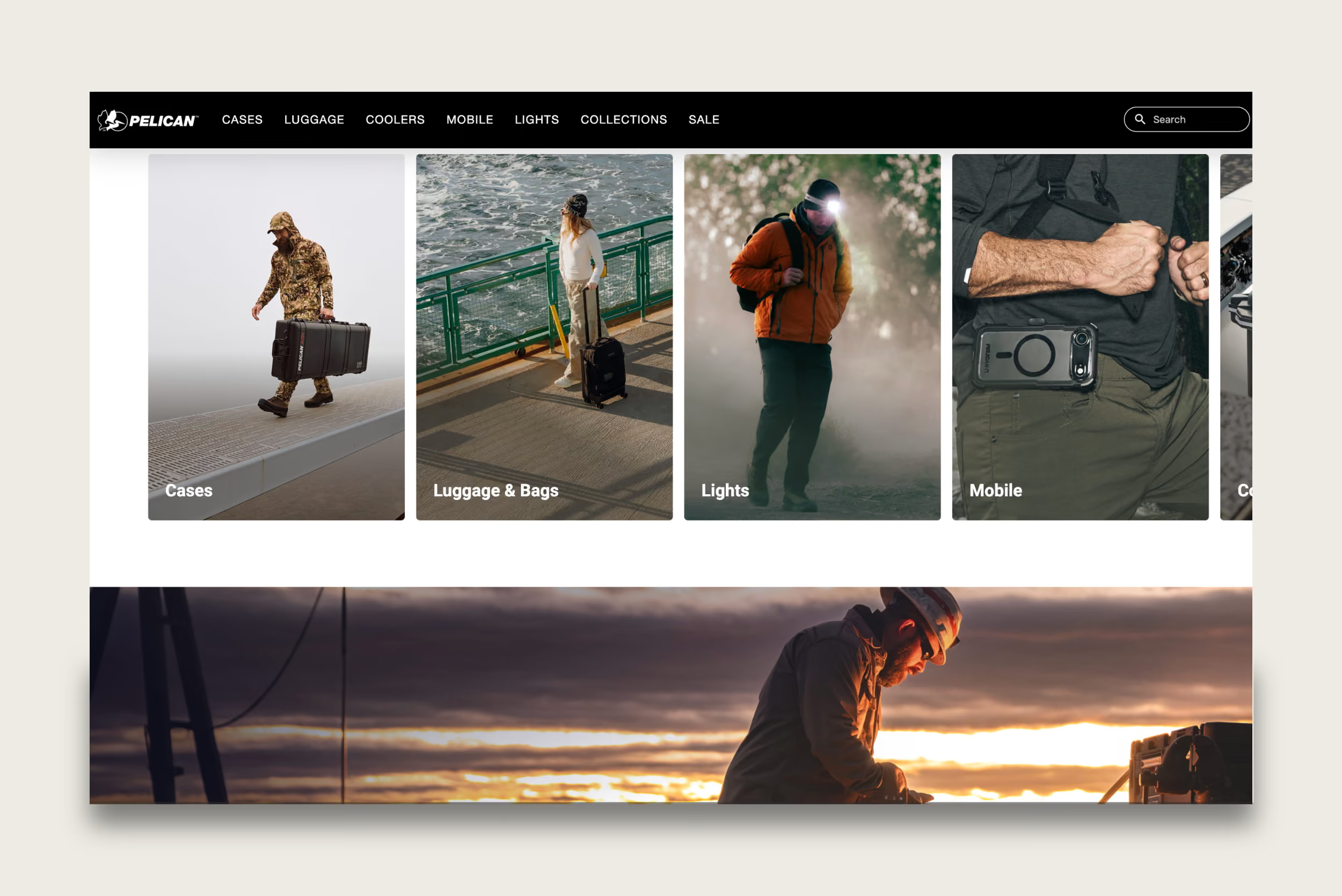
Pelican Increased Conversion 20%+ on Shopify Without Disrupting SAP ERP

Pelican partnered with Zaelab to modernize its customer experience on Shopify while preserving its SAP ERP environment. Using Fuse—Zaelab’s enterprise integration platform for Shopify—the team accelerated SAP connectivity, reduced manual processes, and enabled faster, IT-independent updates across global regions.

Pelican Increased Conversion 20%+ on Shopify Without Disrupting SAP ERP

The Challenge

Pelican’s digital ecosystem had become too fragmented and too dependent on IT to support the pace of the business. Multiple legacy platforms, region-specific sites, and manually maintained product catalogs created operational drag and made even simple updates slow and resource-intensive. Product data differed across markets, merchandising required development support, and the lack of unified analytics limited their ability to optimize the customer journey.

At the same time, aging systems introduced security risks and made it increasingly difficult to scale. Pelican needed a modern commerce foundation that could centralize data, reduce technical overhead, and give business teams the autonomy to move quickly without rebuilding their ERP or overhauling existing back-office workflows.

The Solution

Zaelab partnered with Pelican to implement a modern, headless commerce architecture powered by Shopify, providing a flexible foundation that supports global scalability and consistent customer experiences across regions. The new decoupled frontend allows Pelican to evolve UX independently of backend systems, while Shopify serves as the central commerce engine for managing products, content, and storefront operations.

To connect Shopify with Pelican’s existing business systems, Zaelab leveraged Fuse as the integration layer between SAP, Pelican’s custom PIM, and Shopify, ensuring automated, reliable flows for product data, pricing, and inventory across regions. This architecture established a unified source of truth and replaced the manual, fragmented processes that previously slowed the organization down. It also gave marketing and merchandising teams the ability to manage and push updates directly, reducing dependence on IT for routine catalog and content changes. The solution additionally included enabling marketplace functionality, allowing Pelican to incorporate third-party supplier products within the same unified framework.

Key Integrations

Fuse served as the backbone connecting Shopify to Pelican’s SAP environment and custom PIM, enabling automated, scalable, and reliable data flows across regions. Designed to simplify complex enterprise integrations, Fuse translated SAP’s intricate product, pricing, and inventory structures into Shopify-ready data without custom middleware or brittle point-to-point connections.

Through Fuse, Pelican established more than 10 bi-directional integration flows covering product synchronization, enrichment data, pricing updates, inventory availability, order creation, shipment notifications, and real-time cancellations across the US, CA, and AU regions. These automated processes eliminated manual catalog maintenance and ensured consistent, unified data across systems.

Fuse also provided Pelican with a centralized view of integration activity, offering searchable logs, proactive error notifications, and built-in failover and retry logic—making complex SAP operations easier to manage and troubleshoot. By using Fuse as the connective layer, Pelican set a repeatable integration pattern that can be extended across future phases, additional capabilities, and new regions as the business expands. Because Fuse operates directly within Shopify, teams no longer need to log into multiple systems to manage data or monitor integrations.

The Result

✔ 20%+ lift in conversion

✔ Faster go-to-market with IT-independent updates

✔ Automated global data flows for products, pricing, and inventory

✔ Accurate, unified catalogs powered by SAP and Pelican’s PIM

✔ Optimized checkout with Shop Pay and improved UX

✔ Streamlined marketplace onboarding for third-party products

Business Impact

Pelican now has a commerce foundation that supports the speed and scale of the business. With Shopify at the center and Fuse handling SAP and PIM integrations, the team operates with far less technical overhead and far greater consistency across regions. Product data, pricing, and inventory updates move through the system automatically, giving business teams the confidence to make changes quickly and independently.

The new headless architecture also sets Pelican up for long-term growth, with a structure that can support configurators, expanded regional sites, deeper order-lifecycle integrations, and ongoing optimization efforts. What was once a fragmented, high-maintenance environment is now a unified platform built for efficiency, iteration, and global expansion.

Related Stories

ProjectorScreen.com Gains Speed, Flexibility, and Control with a Custom Shopify Experience

Consumer Products

ProjectorScreen.com Gains Speed, Flexibility, and Control with a Custom Shopify Experience

See how Zaelab helped ProjectorScreen.com migrate to Shopify with a custom theme that empowered internal teams, preserved conversion, and eliminated reliance on developers ahead of peak season.

Read More

Certor Sports Unifies B2B and D2C Operations with Portul, The Only Shopify App to Meet Complex B2B Needs

Manufacturing

Consumer Products

Certor Sports Unifies B2B and D2C Operations with Portul, The Only Shopify App to Meet Complex B2B Needs

Learn how Zaelab helped Certor Sports unify B2B and D2C operations, enhance product visualization, and enable a seamless self-service experience with Shopify and Portul.

Read More

4 & Counting: Multiple Brands Migrate, Replatform on Leading Commerce Solution

Health & Life Sciences

4 & Counting: Multiple Brands Migrate, Replatform on Leading Commerce Solution

Sarnova delivers a robust and scalable B2B digital experience by replatforming and migrating all brands onto a single instance of SAP Commerce.

Read More