PunchOut Catalog Alternatives: Was PunchOut the Right Answer—and Is It Still the Right Question?

Published: November 2026 | Reading time: 8 min
For more than two decades, enterprise buyers and suppliers relied on PunchOut catalogs to connect internal e-procurement systems directly to supplier storefronts. It solved a clear technical problem in 1999: enterprise systems could not read unstructured orders, and buyers needed live pricing without maintaining static price files.
Those constraints no longer apply. AI order ingestion can now read purchase orders in any format—email, PDF, or spreadsheet—apply customer-specific contract pricing, and create clean ERP orders automatically. At the same time, AI buying agents let procurement teams query live stock and contract pricing directly via APIs rather than browsing a storefront.
PunchOut will not vanish overnight, but its footprint will shrink. Here is how the market got here, where PunchOut still outperforms AI, where it adds friction, and what suppliers and buyers need to fix underneath their systems to prepare.
A PunchOut catalog is a B2B e-procurement protocol (built on cXML or OCI standards) that connects a buyer’s purchasing software directly to a supplier’s live storefront. Instead of importing static price files, buyers "punch out" to the supplier's site, build a cart with real-time pricing and availability, and return that cart to their internal procurement system for approval before issuing a purchase order.
Two AI capabilities are eroding the need for this workflow:
Before PunchOut, ordering industrial or commercial parts required manual handoffs: faxing purchase orders, emailing spreadsheets, calling sales desks, or logging into separate supplier portals. Every handoff required the buyer to enter data once and the supplier to rekey it upon arrival, introducing part-number errors and pricing mismatches.
Electronic Data Interchange (EDI) proved in the late 1960s that computers could exchange orders directly, but it depended on rigid formats and dedicated point-to-point setups for every trading partner. By the late 1990s, buyers wanted one procurement system for spend approvals and budgets without hosting stale copies of hundreds of supplier catalogs.
PunchOut bridged that gap:
Ariba created cXML in 1999 as an open standard for this exchange, while SAP built the Open Catalog Interface (OCI) for its own procurement software. Because cXML and OCI are distinct standards, suppliers selling to large enterprises often had to build and maintain both.
A small group of platforms defined the PunchOut ecosystem, and the underlying infrastructure consolidated heavily over two decades.
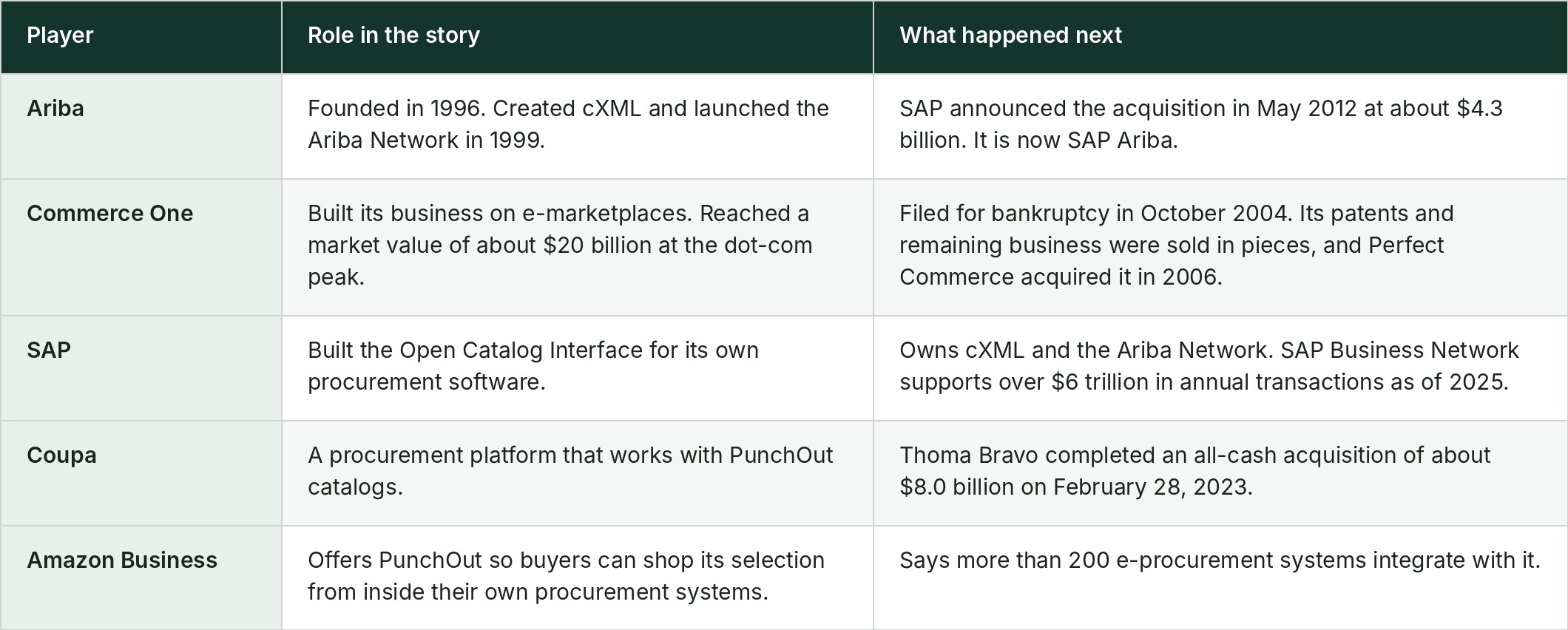
Two patterns define this history. First, the open data standard outlived most of the companies built around it: Commerce One went through bankruptcy in 2004, while cXML and the Ariba Network were absorbed into SAP. Second, ownership consolidated. SAP now controls cXML, the Ariba Network, and OCI, meaning a buyer's procurement system and the standards it speaks frequently trace back to the same few vendors.
PunchOut lasted because it aligned with how enterprise procurement operates:
Any replacement has to match all four capabilities.
Despite its staying power, PunchOut creates operational friction for both buyers and suppliers:
AI order ingestion addresses the root problem PunchOut was built to bypass: converting unstructured buyer requests into clean ERP orders without human data entry.
Modern order ingestion software reads purchase orders arriving as email bodies, PDFs, or spreadsheets, matches line items to the supplier's SKU master, converts units of measure, and applies customer contract pricing. High-confidence orders flow straight into the ERP. Orders with missing data or rule exceptions route immediately to a human specialist.
This reverses the integration burden:
Evaluate vendor accuracy claims carefully—most are self-reported. What determines success in production is exception handling: how fast and reliably the system flags uncertain line items for human review instead of guessing.
Instead of browsing a PunchOut catalog, enterprise buyers are beginning to use AI assistants to ask direct purchasing questions: "What is my contract price and live stock on this requisition list, and which items should I order today?"
Gartner forecasts that AI agents will intermediate more than $15 trillion of business purchasing by 2028, provided suppliers expose verifiable data feeds and standardized trust frameworks.
That data layer is the bottleneck. An AI agent can only quote accurate pricing if the supplier exposes live, account-specific pricing and inventory via machine-readable APIs. Most emerging agent protocols do not yet handle complex contract pricing tiers, corporate account hierarchies, approval thresholds, or net payment terms.
PunchOut retains clear advantages for specific enterprise transactions:
Today, AI delivers the most reliable return in controlled workflows: automated order intake from emails and PDFs, and guided quoting inside an authenticated portal.
Three distinct outcomes are taking shape as AI adoption grows across procurement and commerce:
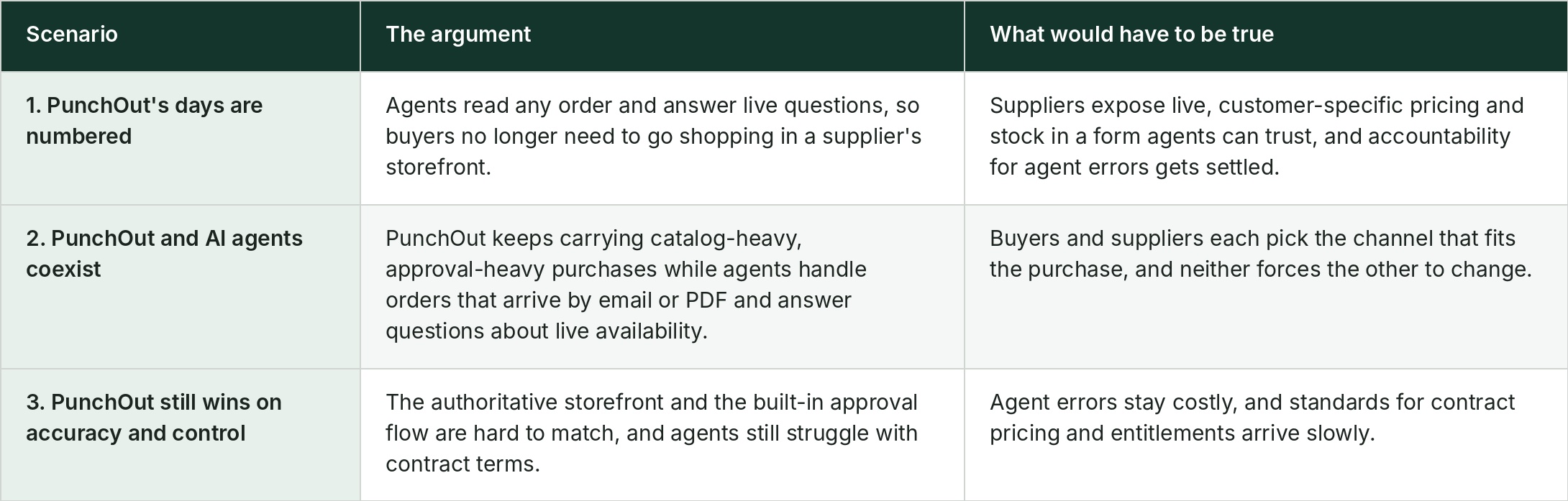
Alt text: Comparison table outlining three future scenarios for B2B PunchOut catalogs alongside AI buying agents, detailing the core argument and technical requirements for each outcome.
Our view leans toward the first outcome, reached through the second: AI agents deploy alongside PunchOut, prove their reliability on routine order intake and stock checks, and gradually absorb more complex purchasing as supplier data foundations mature.
If AI agents become primary buyers, the next standard will be an agent-to-agent protocol rather than a cart returning to a requisition screen. PunchOut's lasting contribution remains the rule it established in 1999: buyer and supplier systems need a common language to transact.
Regardless of which channel wins, an AI agent is only as reliable as the pricing, product, and order data underneath it.
For enterprise suppliers:
For enterprise buyers:
Across commerce, quoting, and order management, human employees routinely work around disconnected seams between systems, while AI agents hit those seams and break. Suppliers capture the highest return when customer, pricing, and order data flow along one connected path from Customer to Cash—turning a Friday-afternoon PDF into a confirmed order without manual rekeying.
If you want to identify where your order intake path breaks down, a focused discovery and systems audit is the most practical place to start.
PunchOut solved the constraints of 1999, but AI is rewriting how buyers and suppliers connect. Where does your team land?
If you lead procurement, digital commerce, or supplier operations, share where you land and what you are seeing in production.
Your customer sees one company. Your systems should too.
A PunchOut catalog is a B2B e-procurement protocol (using cXML or OCI standards) that lets a buyer access a supplier's live storefront directly from inside their internal purchasing system, such as SAP Ariba or Coupa. The buyer builds a cart with live contract pricing and inventory, then returns the cart to their procurement system for approval before generating a purchase order.
The primary alternatives to traditional PunchOut catalogs include:
In the near term, AI agents and PunchOut will coexist. AI order ingestion is already replacing manual PDF and email order entry, while conversational agents handle inventory checks and routine reorders. PunchOut remains dominant for complex, configurable products and strict procurement approval workflows until standards for agent-based contract pricing and purchasing liability mature.
cXML (Commerce eXtensible Markup Language) was created by Ariba in 1999 and is the most widely used open protocol across e-procurement platforms like SAP Ariba, Coupa, and Jaggaer. OCI (Open Catalog Interface) is SAP's proprietary protocol designed specifically to connect supplier catalogs with SAP ERP and SAP procurement modules.
Are you leading the way or falling behind?
Learn where your B2B business stands compared to industry competitors.
Request a Proposal