Reading time: 7 min | Series: Part 2 of 3
If you are searching for SAP Commerce Cloud alternatives (or SAP Hybris alternatives, as many teams still call them), the Accelerator end-of-life dates probably started the search. Part 1 of this series covered those dates. This post covers the platforms that make a credible shortlist and the questions that narrow it. For wider context on the SAP Commerce Cloud decision, including why SAP can stay your ERP and system of record, see our earlier post, When to Migrate Off SAP Commerce Cloud: Options and Guide.
For B2B and hybrid commerce teams coming off the Accelerator, the platforms that most often reach the final shortlist are Shopify Plus, BigCommerce, Adobe Commerce, commercetools, and Salesforce Commerce Cloud, along with keeping SAP Commerce as the backend behind a new storefront. The right answer depends on your GMV, your B2B complexity, how deep the SAP tie runs, and what your team can operate. Four calls cover most situations:
Adobe Commerce still handles the most complex B2B catalogs better than almost anyone, and it is shedding stores fast. Salesforce Commerce Cloud makes sense if you already run three or more Salesforce clouds, and rarely otherwise.
Six options belong on most shortlists coming off the Accelerator. Your profile matters far more than any feature grid, so each row carries an honest caveat.
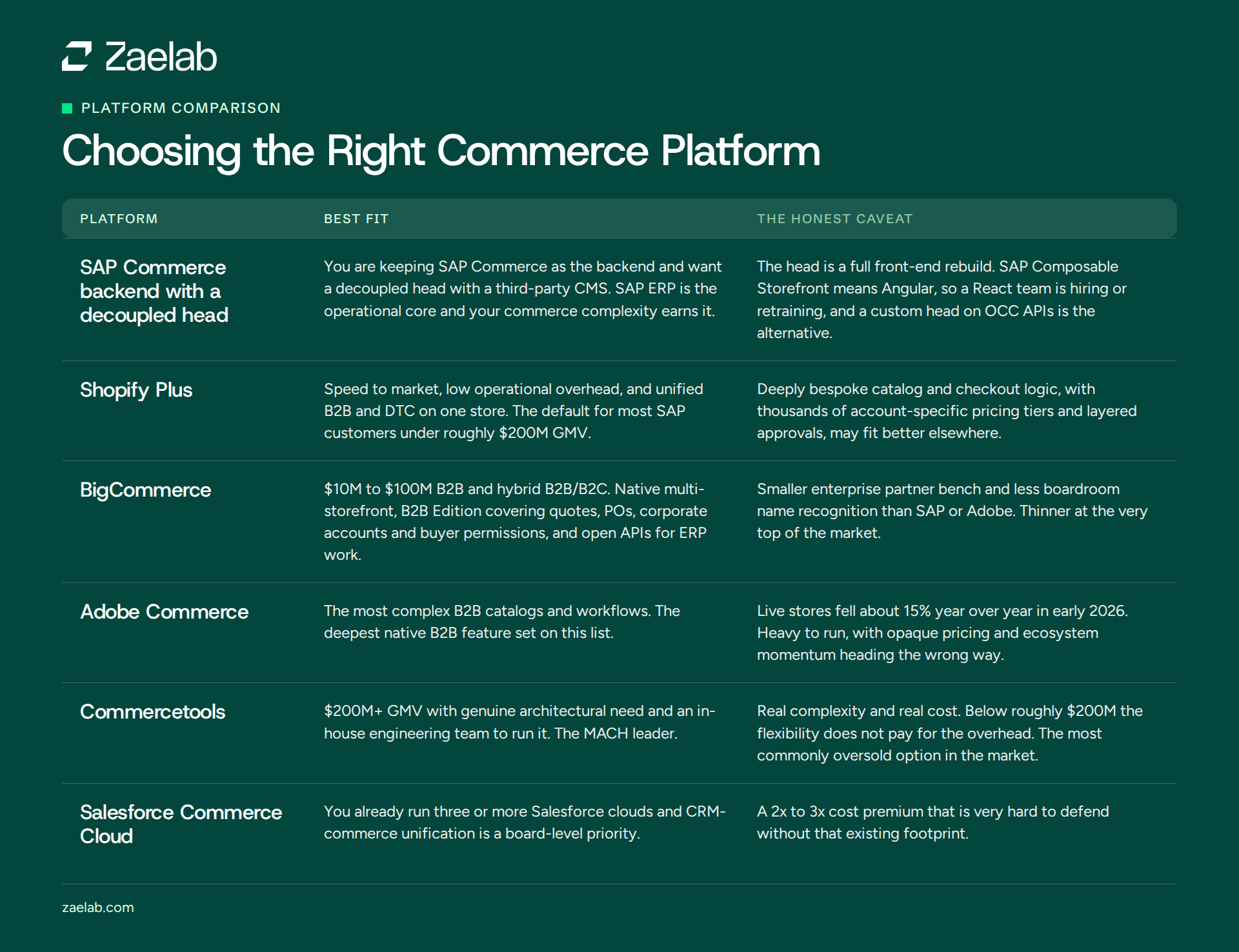
Keep it when the decision holds up under two tests. First, your pricing, catalog, and order logic are tightly bound to the SAP data model, so moving them would cost more than the storefront rebuild. Second, your team already has SAP Commerce skills and the complexity of your business earns the platform. If both are true, a decoupled head and a third-party CMS give you a modern storefront and a better authoring experience on a backend you already run.
The tie is thinner than it looks when SAP Commerce is mostly a storefront in front of an ERP you integrate with anyway. In that case the rebuild is your opening to evaluate other backends, and your ERP integration can stay platform-agnostic either way.
For $10M to $100M B2B, yes. B2B Edition brings purchase orders, quote management, corporate accounts, buyer-level permissions, shared shopping lists and granular price lists natively, instead of as three third-party contracts you integrate and then own. For an SAP B2B shop, that list covers most of what the Accelerator was doing. It is also open SaaS with a headless-ready architecture, with open APIs for ERP integration and no revenue-tied transaction fees.
Elogic's 2026 band analysis puts BigCommerce Enterprise at its highest market share in the $10M to $50M tier, and an IDC study validated a 391% three-year ROI for mid-market B2B. Treat those figures as directional. The ceiling shows up with extreme catalog complexity, very large programs where partner depth is part of the risk model, and organizations above a few hundred million in GMV.
For most SAP customers under roughly $200M GMV, it is the efficient default. B2B is included in Plus with no separate license, unified B2B and DTC on one store is now realistic, and Shopify B2B GMV grew 96% across 2025. Shopify's own analysis puts its TCO about 33% below competitors on average, and vendor-published comparisons deserve some skepticism. Where Shopify Plus fits less well is deeply bespoke catalog and checkout logic with thousands of account-specific pricing tiers and layered approvals.
Usually not. Composable commerce is used by roughly 34% of companies above $1 billion in GMV, up from 26% in 2024, and adoption falls off sharply below $200 million. Below a certain scale, flexibility costs more than it returns. Mid-market companies have bought composable, spent two years and a small fortune assembling the pieces, and landed somewhere slower to change than the monolith they left, because every change now touches five vendors on five release cadences.
SAP's own recommended direction is headless and composable, which is reasonable advice from a platform vendor with a decade of architecture to modernize. It may be a poor fit for a $60M distributor with four developers. The useful question is whether you have the scale, the team, and the architectural need to make composable pay off. For most companies under a few hundred million in GMV, the answer is no, and saying so in the steering committee is worth more than any slide in the deck.
Answer these in sequence and the field narrows before anyone builds a scorecard.
Committees often run the demos first and then build requirements around whatever impressed the room, which hands the vendor with the best demo team the job of writing your requirements. Reverse the order. Answer the five questions, narrow to two platforms on profile alone, then bring in demos to choose between finalists that both already fit.
A platform losing customers is also losing partner quality, talent, and roadmap investment, and those are what you are buying for the next five years. Adobe Commerce live stores fell about 15% year over year in early 2026, though it still powers an estimated $173 billion in annual GMV, so this is erosion and falls short of collapse. Commercetools crossed a $100 billion annualized GMV run-rate in early 2026. In the $50M to $200M band no platform holds more than 31% share, which makes that band a genuine six-way decision.
No. In the migrations we lead, SAP stays the system of record for pricing logic, inventory, financials, and fulfillment, and the commerce layer moves to a platform that can change at its own pace. Our post on when to migrate off SAP Commerce Cloud covers that model in more detail.
Once you have two finalists, the next question is what the rebuild will cost and how to run it without breaking production. Part 3 covers the budget, the timeline, and a migration approach that holds up under a fixed deadline. If you want a second opinion on your shortlist, our team is here.
What is the best alternative to SAP Hybris? There is no single best option. Under roughly $100M GMV, BigCommerce or Shopify Plus usually fits. Above $200M with real architectural complexity, commercetools or a decoupled SAP Commerce backend earn their seats.
Is Adobe Commerce still worth considering? For the most complex B2B catalogs, yes. It has the deepest native B2B feature set on the list, with the caveats of heavy operations, opaque pricing, and falling store counts.
Is Salesforce Commerce Cloud an alternative to SAP Commerce Cloud? It can be, when you already run three or more Salesforce clouds and CRM-commerce unification is a board-level priority. Without that footprint the cost premium is hard to defend.
Does SAP Composable Storefront require Angular? Yes. SAP Composable Storefront (formerly Spartacus) is built on Angular. Teams on React can hire or retrain, build a custom head on SAP's OCC APIs, or choose another platform.
Are you leading the way or falling behind?
Learn where your B2B business stands compared to industry competitors.
Request a Proposal
