Published: November 2026 | Reading time: 7 min
Salesforce's End of Sale (EOS) for legacy CPQ forces every current customer to choose a new direction. Staying on legacy CPQ is not a viable long-term strategy, so every path involves a move, and the right one depends on your product catalog, tech stack, and goals.
Most evaluations focus on the quoting engine: product catalog modeling, pricing rules, and line-item logic. That work matters, but it covers half the job. A quote is an intent to buy. The contract creates the obligation.
In most CPQ setups, the handoff between the two is still the slowest and riskiest step from lead to revenue: static document generation, legal approvals outside the CRM, manual redlining, and signed agreements that live apart from order and subscription records. Each one adds friction, slows time to revenue, and exposes the business to legal and financial risk.
This post explains how to connect CPQ and contract lifecycle management (CLM) with Docusign, so the quote and the signed agreement run as one flow.
Salesforce has ended sales of legacy CPQ but has not retired it. Salesforce confirmed End of Sale (EOS) in early March 2025, which closed the product to new customers. Existing customers keep access and support and can still add licenses. No direct upgrade path exists.
Salesforce has not published an official End of Life date. The 2029 to 2030 estimates you may have seen come from analysts, so treat them as planning assumptions.
Because Salesforce Revenue Cloud requires a full reimplementation, staying inside the Salesforce ecosystem carries about the same weight as moving to a new platform. Every current customer faces the same fork:
Whichever direction you take, evaluate three things before anyone scopes the work:
For a longer side-by-side look at the paths, read our comparison of Salesforce CPQ alternatives.
CPQ (configure, price, quote) owns the product catalog, pricing rules, bundling, and discounting. CLM owns the agreement: dynamic document generation, redlining and negotiation, signature, and the contract lifecycle after signing. Docusign IAM and CLM cover that second layer.
Evaluations follow the product catalog and the pricing engine, because that is what the CPQ team owns. Document generation, legal approval, and agreement workflows sit with other teams and other tools. The result is a modern quoting engine feeding the same static templates, email-based redlines, and manual contract data entry as before. The new platform is faster to quote but not faster to close.
That is the execution gap: the back half of the customer-to-cash journey, where a priced quote has to survive negotiation, approval, signature, and tracking. It is where discounts, terms, and renewal conditions drift from what finance and legal approved.
The quoting engine you choose will change. The agreement layer is the piece you can modernize now and carry across any of those choices.
Three places account for most of the delay and risk between an approved quote and a live subscription.
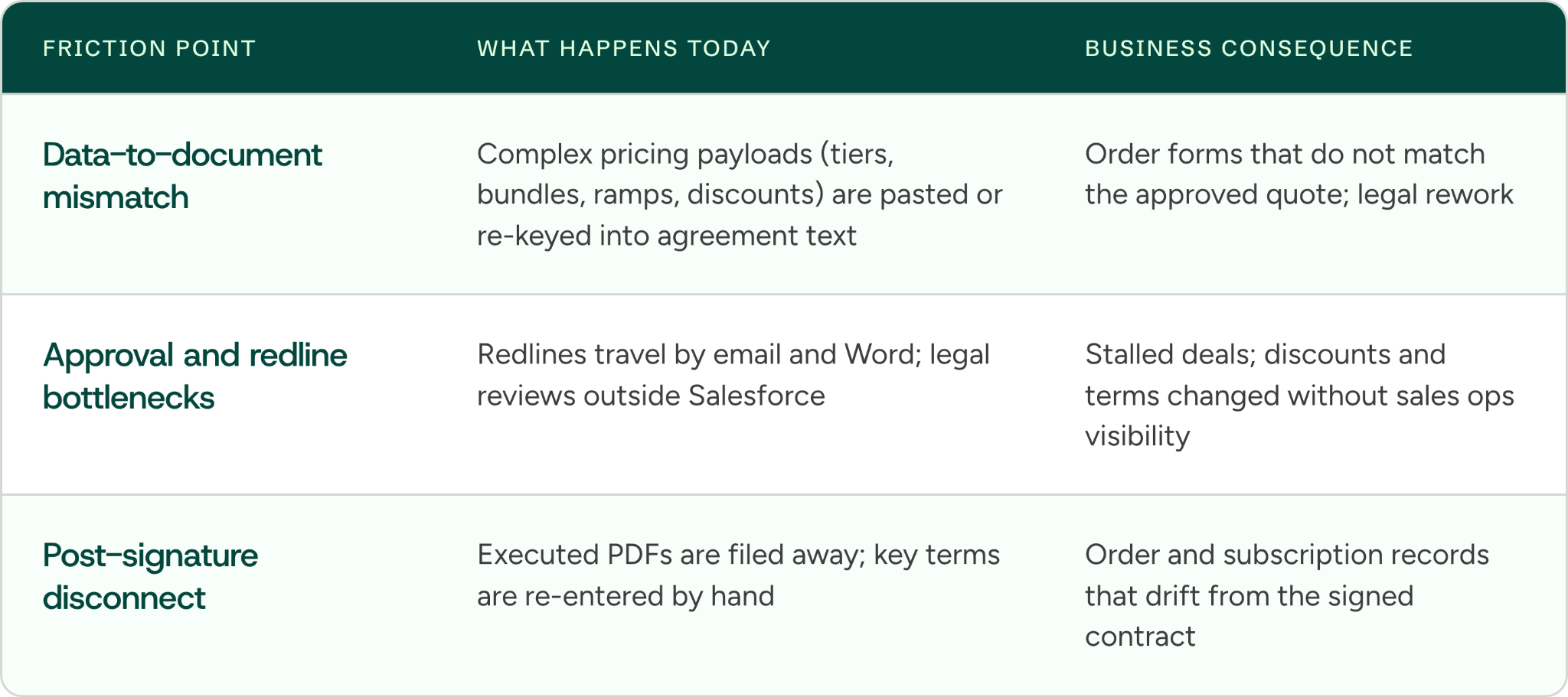
A CPQ quote can carry hundreds of lines, nested bundles, tiered or ramped pricing, and conditional discounts. Static templates flatten all of that into a table and leave someone to add the conditional terms (payment, renewal, usage limits, SLAs) by hand. Every manual step is a chance for the agreement to say something different from the quote. It is a close cousin of the unfulfillable quote problem, just showing up later in the deal.
CPQ approvals cover pricing. Legal approvals cover language. When the second happens in email and shared drives, sales operations can't see where a deal is, which clauses changed, or whether a concession breaks pricing policy. A fast quote ends up waiting on a slow negotiation.
Once signed, the contract holds the obligations that finance, customer success, and renewals depend on: start dates, term, escalators, notice periods, renewal conditions. If those terms stay in a PDF, the order and subscription records in Salesforce are only as accurate as the last person who typed them in.
The fix is a single, governed flow where the quote drives the agreement and the signed contract updates downstream records on its own. Drafting, negotiation, signature, and archiving can all run inside the CRM and quoting tools your sellers already use, while legal and operations keep live visibility into reviews, compliance, and renewals.
Keep the CRM and CPQ as the system of record for commercial data, and Docusign as the system of record for the legal agreement. Then sync them in both directions:
The system builds documents from CPQ data instead of static templates. Rules based on products, term length, and discount thresholds pull in the right legal terms and required approvals. Legal keeps control of the template language and clause library, and sales stops editing contracts by hand.
AI scans counterparty redlines, flags non-standard terms, and suggests approved fallback language, so review cycles get shorter. Exceptions route to the right reviewers in Finance and Legal, and account teams can evaluate terms and manage approvals without leaving their daily tools.
The payback shows up in three places: speed, margin, and risk. Treat the figures as outcome targets to baseline in your own environment, not benchmarks.
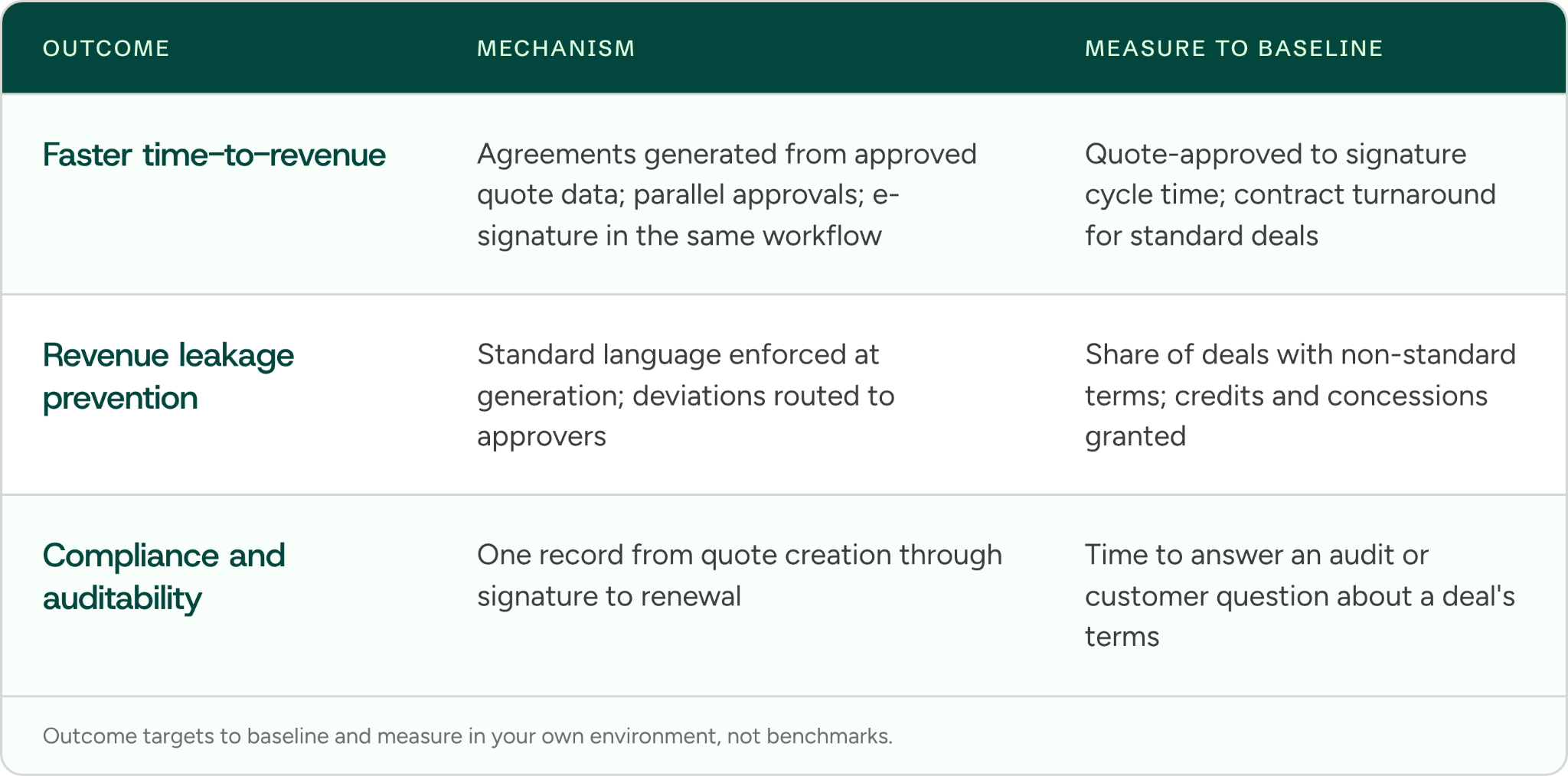
Standard deals shouldn't wait on legal. When the system generates the agreement from approved data and the clause library already encodes legal's position, routine contracts can move from quote to signature without a manual drafting step. Legal time goes to the exceptions that need judgment.
Leakage hides in the gap between what the business approved and what the customer signed: an unapproved discount in a side letter, a rogue payment term, a renewal clause that auto-renews at last year's price, or not at all. Enforcing rules at generation, and extracting signed terms back into Salesforce, closes that gap.
A full trail from quote creation, approvals, and redlines through signature and renewal tracking answers who approved what, when, and why. It supports audits, revenue recognition reviews, and customer disputes without reconstructing history from email.
A CPQ evaluation that ends at the quote has solved half the problem. Before you commit to a direction and a vendor plan, work through this list:
Teams that modernize both layers should expect faster, more predictable deal cycles, pricing and terms that match what the business approved, renewal conditions you can see before you miss them, and a clean audit trail from first quote to renewal. They also build a foundation for AI agents that can act on agreements safely, because the data underneath has structure and governance. We covered why that foundation has to come first in our CPQ governance playbook.
If you're weighing a CPQ move and want to talk through where the quote-to-agreement handoff breaks in your setup, reach out here. Your customer sees one company. Your systems should too.
What is the execution gap in CPQ?
The execution gap is the stretch between an approved quote and a signed, tracked agreement. Pricing and configuration are the front half of a deal. Turning that priced quote into a negotiated, approved, signed, and tracked contract is the back half, and it rarely appears in a CPQ evaluation.
What is the difference between CPQ and CLM?
CPQ (configure, price, quote) owns the product catalog, pricing rules, bundling, and discounting, and produces the quote. Contract lifecycle management (CLM) generates the agreement from that quote, runs redlining and negotiation, collects the signature, and manages the contract after signing. CPQ holds the commercial intent. CLM holds the legal obligation.
How do CPQ and CLM work together?
Quote and quote line data populate the agreement when the system generates it, so nobody retypes pricing. After signature, the agreement status, signature events, and extracted key terms write back to the quote, contract, order, and subscription records. A persistent link ties each commercial record to its agreement, so you can trace a change on either side.
Does Docusign work with CPQ platforms other than Salesforce?
The architecture in this post keeps the agreement layer separate from the quoting engine, so Docusign IAM and CLM can sit downstream of Salesforce Revenue Cloud, ServiceNow CPQ, or another CPQ platform. Confirm the specific integration for your platform during evaluation.
When does Salesforce CPQ reach end of life?
Salesforce has not published an official End of Life date for legacy CPQ. It confirmed End of Sale in early March 2025. Analyst estimates of 2029 to 2030 are planning assumptions, not Salesforce commitments.
What should we measure after connecting CPQ and CLM?
Baseline three things in your own environment: the cycle time from quote approval to signature, the share of deals with non-standard terms along with the credits and concessions granted, and the time it takes to answer an audit or customer question about a deal's terms.
Are you leading the way or falling behind?
Learn where your B2B business stands compared to industry competitors.
Request a Proposal