

Shopify has unveiled its Winter ’26 Edition — the Renaissance Edition — rolling out 150+ product updates that push the platform into a new era of AI-native, data-driven commerce. The new edition marks a shift from feature expansion to intelligent commerce execution.
While many improvements focus on AI and automation broadly, a closer look reveals meaningful progress for B2B manufacturers, distributors, and wholesale brands navigating complex buyers, multi-system operations, and growing expectations for self-service.

This release reinforces a pattern we’ve explored in depth at Zaelab: Shopify is no longer adapting B2C tools for wholesale use. It’s building purpose-driven B2B capabilities that support scale, flexibility, and customer-led growth. That trajectory is exactly why Shopify continues to emerge as a leading B2B commerce platform, especially for organizations modernizing without over-engineering their tech stacks.
Below, we break down the most important Winter ’26 updates for B2B commerce, organized by how they impact growth, operations, and buyer experience.
Four AI-Powered Updates for B2B: From Automation to Agentic Commerce
The Winter ’26 Edition marks a turning point in how Shopify applies AI to B2B commerce. Instead of using AI only for efficiency gains, Shopify is embedding intelligence directly into how teams operate, how buyers discover products, and how commerce happens across new channels.
For manufacturers and distributors, these AI-powered updates focus on three things: reducing manual work, improving decision-making, and meeting buyers earlier in their journey. From in-admin guidance to AI-driven discovery and agent-enabled purchasing, Shopify is laying the groundwork for B2B commerce that’s more proactive, connected, and scalable.
1. Sidekick: AI-Driven Business Recommendations for B2B Teams
Sidekick takes a clear step forward in the Winter ’26 Edition, moving beyond basic help and into practical, in-admin guidance for B2B teams. Instead of jumping between reports, tools, and spreadsheets, teams can use natural language to analyze performance, get recommendations, and complete tasks directly inside Shopify.
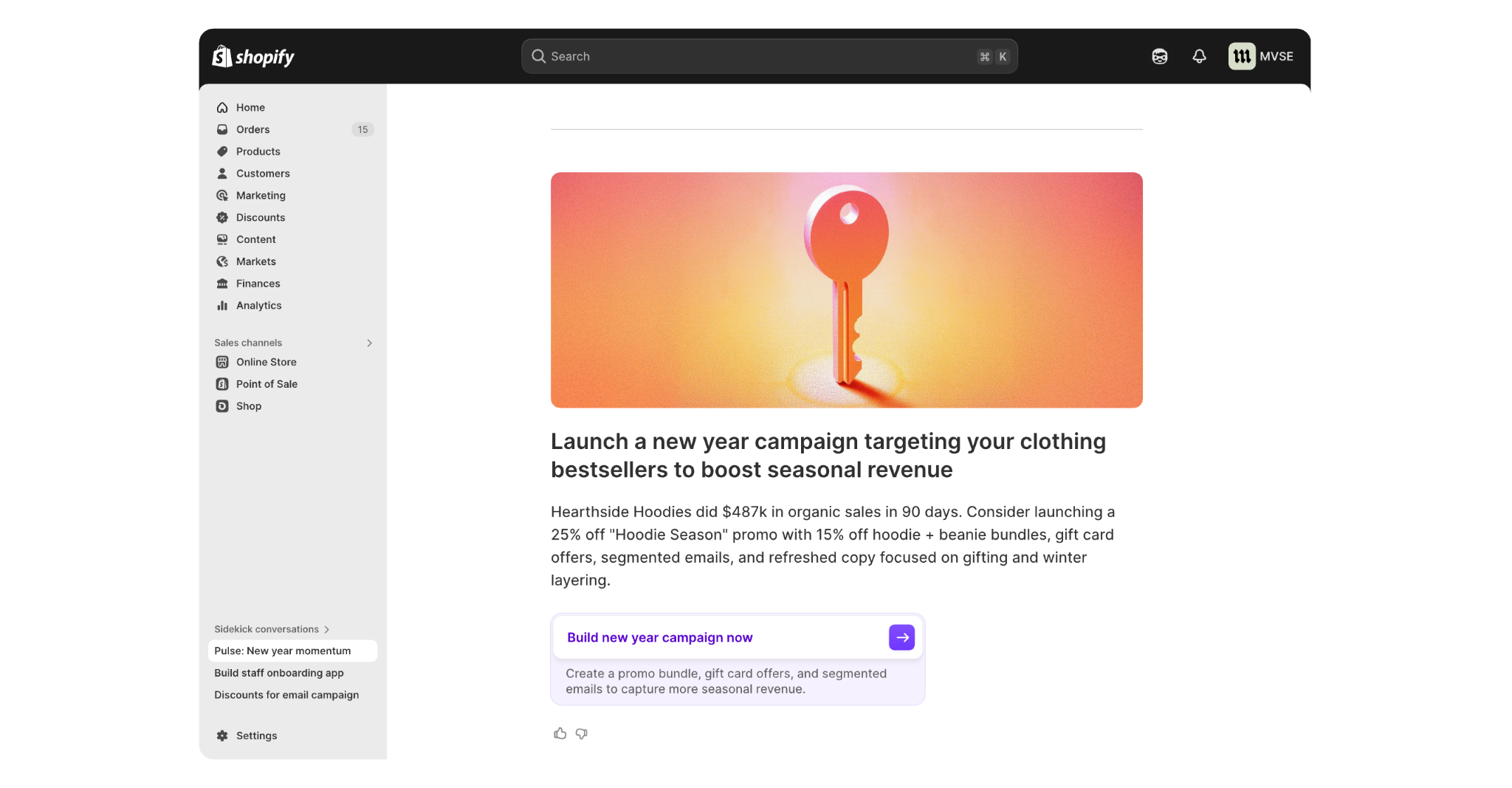
For manufacturers and distributors managing complex catalogs and customer accounts, Sidekick helps reduce manual work and speed up decision-making. B2B teams can use it to:
- Generate and visualize custom analytics (sales, margins, discounts, returns)
- Create or update products, collections, customers, and B2B companies
- Get app recommendations based on specific operational goals
- Follow guided to-do lists for setup and ongoing management
By turning data into action inside the admin, Sidekick supports a core B2B need: moving faster without adding complexity.
2. Shopify Agentic Storefronts: Being Discoverable in AI-Driven Buying Journeys
Shopify’s Winter ’26 Edition introduces Agentic Storefronts, enabling brands to control how their products appear and transact inside AI-powered conversations. B2B products can now be discovered directly in tools like ChatGPT, Copilot, and Perplexity, with more channels coming soon. This reflects a major shift in how buyers research suppliers, validate options, and begin purchasing — often before they ever visit a traditional storefront.
For manufacturers and distributors, this means Shopify is extending B2B commerce beyond the website. Product data, availability, and checkout can now surface inside AI tools buyers already use. As we’ve explored in Modernizing B2B Selling Experiences, meeting buyers where they start their journey is becoming just as important as optimizing the storefront itself.
Why this matters for B2B commerce:
- Buyers can discover products through AI research and recommendations
- Brands maintain control over how products appear in AI chats
- Shopping flows can move from conversation to checkout seamlessly
3. Agentic Commerce and AI Tools for Builders
Alongside agentic storefronts, Shopify is rolling out a new AI-first developer foundation designed to support agent-driven commerce experiences. Rather than building complex integrations from scratch, teams can use Shopify’s catalog and checkout tools to bring native shopping into AI conversations.
At a high level, these updates allow:
- AI agents to access Shopify’s product catalog
- Checkout to be embedded into agentic flows across web and mobile
- Faster development of headless and AI-enabled commerce experiences
For B2B organizations, the value is in what this tooling enables. These capabilities make it easier to support longer buying cycles, assisted selling, and research-heavy purchases, all while staying connected to Shopify’s core commerce engine.
This flexibility is one reason Shopify continues to stand out as a platform that scales with B2B complexity, not against it.
4. Know Your Customer Better with AI-Powered A/B Testing
Winter ’26 expands Shopify’s AI-powered A/B testing capabilities, making it easier to test messaging, layouts, and experiences with less manual setup.
In B2B, where buying journeys vary by role, account size, and contract structure, this is especially valuable. Teams can experiment with:
- How different customer segments respond to product grouping
- What drives adoption of self-service workflows
- Which experiences reduce fallback to sales or support
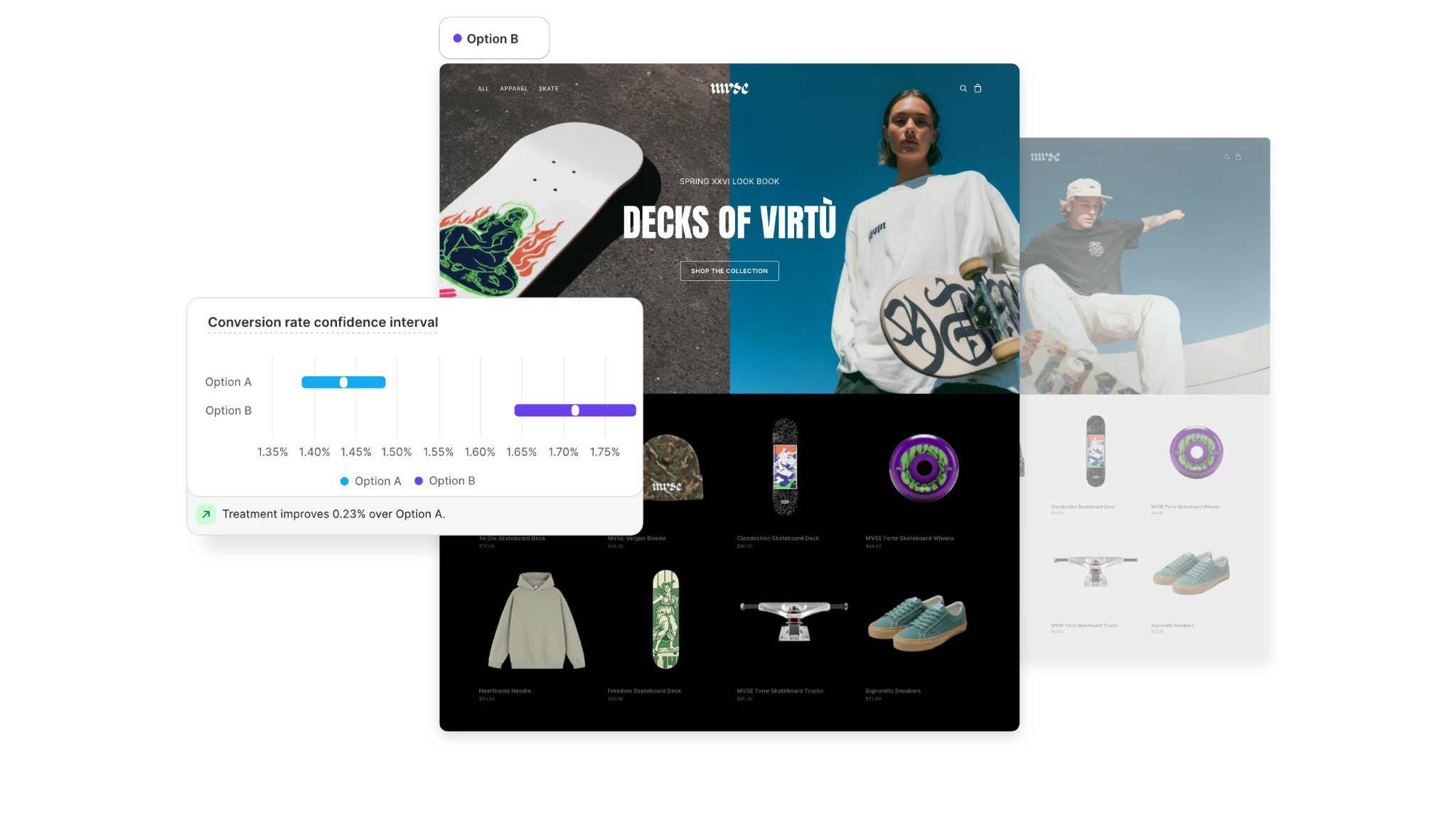
This insight-driven approach reflects a broader shift we’re seeing across enterprise commerce: modernization happens fastest when teams optimize from the customer’s point of view, not internal assumptions.
B2B Operations: Smarter Workflows, Flexible Inventory, and Clearer Insights
The Winter ’26 Edition brings meaningful operational improvements designed for the realities of B2B commerce where inventory doesn’t always move cleanly between known locations, orders span channels, and leaders need visibility without digging through reports. Shopify is expanding how teams manage inventory, sales, and analytics to better reflect real-world workflows.
At a high level, these updates help manufacturers and distributors reduce friction in day-to-day operations, improve accuracy, and spot trends faster — without adding new systems or manual work.
More Flexible Inventory Modeling
Shopify now supports inventory transfers that better match how B2B supply chains actually work. Teams can receive items from unspecified or external locations, edit shipments while in transit, and maintain a complete inventory history without time limits.
Key benefits for B2B teams include:
- Better handling of supplier shipments and external warehouses
- Improved accuracy across multi-location inventory
- Clearer audit trails with full inventory adjustment history
Faster Selling and On-the-Go Operations
With quick sales in the Shopify mobile app, teams can process simple in-person transactions instantly — useful for trade shows, warehouses, pop-ups, or showroom sales. Combined with Tap to Pay and payment links, this supports hybrid selling without requiring full POS setups.
More Actionable Analytics
Winter ’26 also enhances analytics to make insights easier to spot and act on:
- Heatmaps to identify peak sales times
- Bot filtering for cleaner conversion data
- Minute-level date and time controls for flash sales and launches
- Single-view analytics across multiple stores
Together, these updates give B2B leaders a clearer picture of performance while making everyday operations more resilient and responsive. Instead of forcing complex workflows into rigid systems, Shopify continues to adapt the platform to how B2B businesses actually run.
Personalized Buyer Experiences: Modernizing B2B Growth Through the Customer Lens
Across the Winter ’26 Edition, Shopify continues to reinforce an idea that we at Zaelab deeply believe in — the most effective B2B experiences should be built from the buyer outward. Rather than forcing customers into rigid workflows, the platform is expanding tools that let teams tailor pricing, payments, discovery, and checkout based on who the buyer is and how they prefer to engage.
For B2B organizations, this shift supports more self-service without losing control. Personalized buyer experiences help reduce friction, keep customers in digital channels longer, and create consistency across complex accounts and purchasing roles.
Key ways Shopify supports customer-led B2B experiences include:
- Flexible payment terms, deposits, and store credit by company or location
- Buyer-specific pricing, quantity rules, and catalogs
- Discovery and purchasing that starts earlier in the research journey, including AI-driven touchpoints
This direction closely aligns with one of our core predictions in the B2B Commerce Trends & Predictions for 2026 report: organizations that modernize around the customer — not internal structure — will scale faster and adapt more easily as buying behavior continues to change.
B2B-Specific Commerce Updates in Shopify Winter ‘26 Edition
The Winter ’26 Edition includes a strong set of B2B-specific updates focused on expanding wholesale reach, simplifying payments, and supporting more flexible commercial relationships. Together, these improvements help enterprises grow beyond existing channels while reducing friction across ordering, fulfillment, and finance.
Rather than treating wholesale as a separate system, Shopify continues to fold these capabilities directly into the core platform — making it easier to scale B2B without adding operational overhead.
Wholesale Expansion with Shopify Collective (Now Global)
Shopify Collective is now available in 35 additional countries, opening the door for B2B brands to source products, discover retailers, and expand distribution globally — all from the Shopify admin.
With Collective, businesses can act as a supplier, a retailer, or both:
- Retailers can import products from suppliers without holding inventory
- Suppliers can get discovered by retailers, share price lists, and expand reach
- Products can be published and sold without custom integrations
New discovery tools also allow suppliers to find and connect with retailers proactively, making Collective a practical channel for wholesale growth rather than a passive marketplace.
More Flexible B2B Payments and Financial Controls
Winter ’26 expands how B2B businesses manage payments and terms, especially for higher-value, multi-shipment orders.
Key updates include:
- ACH payments for B2B (Plus, U.S.), allowing buyers to pay by bank transfer at checkout
- Payment requests per fulfillment (Plus), supporting partial shipments and staged billing
- Store credit for B2B, issued at the company or location level
- Dynamic payment terms and deposits (Plus) using Shopify Functions
These tools help align checkout and billing with real-world B2B agreements, reducing manual invoicing and follow-up.
Order Control, Fulfillment, and Self-Service Improvements
To support complex buying and fulfillment scenarios, Shopify also introduced updates that give B2B teams more control without slowing down operations:
- Rules to flag orders for review based on value or products (Plus)
- Pickup in store as a checkout option for B2B buyers
- New B2B-compatible apps for quotes, buyer roles, and shopping lists
- Horizon themes fully supporting volume pricing, quantity rules, and quick order lists
Stronger ERP and EDI Connectivity
Winter ’26 continues Shopify’s push to act as a connected commerce layer within enterprise environments. Pre-built integrations now support syncing companies, orders, and payment terms with ERPs like NetSuite, BrightPearl, Sage, Fulfil, and Acumatica, along with direct EDI workflows through Crstl and SPS Commerce.
For B2B organizations, this means fewer manual touchpoints, cleaner data flows, and faster order processing without sacrificing flexibility on the front end.
From Feature Updates to AI-Connected Commerce
Taken together, these B2B updates show how Shopify helps enterprise businesses grow faster, offer more flexible buying and payment options, and stay connected across systems — all while keeping the customer experience simple.
From AI-powered operations to global wholesale expansion, Winter ’26 makes it clear that B2B is not a secondary platform capability, but a growth focus for Shopify.
The B2B Commerce Spectrum, developed by Zaelab in partnership with Shopify, builds on this same foundation. It helps B2B teams understand how well their current commerce experience supports growth and where the biggest opportunities exist across experience, operations, and technology.


